CrowdHealth Cost: What My Family of 3 Actually Pays Monthly
If you’ve been Googling “CrowdHealth cost” and getting frustrated by vague answers, I get it.
Most reviews either throw out a number without context or bury the actual math in so many caveats that you still can’t figure out what you’d personally pay. I’m going to fix that.
I’ve been a CrowdHealth member with my family of three for a few years now. Before that, we navigated a healthshare plan that sent us to collections while I was recovering as a new mother—they did eventually pay, but only after hours and hours of phone calls and follow-up during one of the most vulnerable times of my life.
Then we moved to a private self-employed health insurance plan through an agent I trusted. We paid $1,483 a month for the three of us. And then I ended up in the ER with acute pain, the intake was coded in a way that made all of my testing ineligible for coverage, and despite trying to get the records amended I eventually gave up and took on a $3,000+ medical bill that we have been paying down monthly for over two years.
That’s when I decided I was done paying for something too complicated to actually use. I started researching alternatives, went down a very deep rabbit hole — read the entire member guide, watched all the tutorials — and we switched to CrowdHealth.
In this post I am sharing the honest math on what it costs, as well as some of the nuances and options you have when working with this membership.
Disclosure: I am a CrowdHealth affiliate and will receive a commission if you sign up using my link. I only promote products my family personally uses. All pricing and program details sourced from JoinCrowdHealth.com s of June 8, 2026. If pricing or terms have changed since then, please rely on the current CrowdHealth website.
First: Understanding the Two-Part Cost Structure of CrowdHealth Membership
CrowdHealth has two separate cost components every month, and this is where most people get confused when they try to compare it to traditional insurance.
Part 1 is the Member Advocacy Fee: $60 per member, per month. This is the flat fee you pay CrowdHealth as a company. It covers your access to their platform, your Personal Care Advocate, bill negotiation services, provider search tools, prescription discounts, unlimited virtual care, unlimited virtual talk therapy, and other member tools. This is what keeps the lights on at CrowdHealth. Every member pays this, every month, no matter what.
Part 2 is the Crowdfunding Ask: each month, you may be asked to contribute to another member’s medical bill. This is the “crowd” in CrowdHealth. Your contribution goes directly into that member’s account (CrowdHealth never pools or touches that money). The amount you’re asked varies each month based on community need, but it will never exceed your set maximum.
So each month you see the first part of your charge hit on the date of the month your membership started. And then the crowdfunding ask will be emailed to you. On rare occasions it may be 2 different emails / contributions to total up. But it will never be over your Max Ask. It's just different from what people are used to, with a lump sum insurance premium payment.
THE KEY THING TO UNDERSTAND:
Your monthly maximum is not what you always pay. It’s the ceiling. In many months, the actual ask is significantly lower. In April 2026, for example, the average crowdfunding ask for a family of 4+ members was $255—not the $420 maximum.
Second: The Actual Numbers Of The Original Membership
CrowdHealth currently offers two membership tiers. The Original Membership is their full-service option — everyday care, unexpected events, bill negotiation, all the member tools.
Here’s what the original membership currently costs:
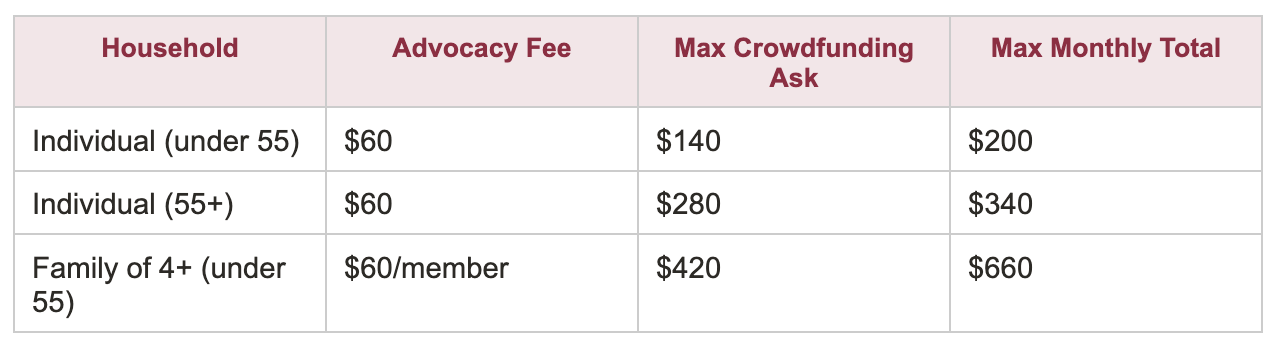
There is also a Member Commitment of $500 per health event — this is what you pay out of pocket before the crowd steps in to fund the remainder of eligible bills. For pregnancy, the Member Commitment is $3,000.
The Black Swan Membership (A Leaner Option)
CrowdHealth recently added a second tier called the Black Swan Membership. This is a stripped-down option designed for major medical events only — no everyday care tools, no bill negotiation for routine things, higher personal responsibility.
Here’s how the cost of the Black Swan plan compares:
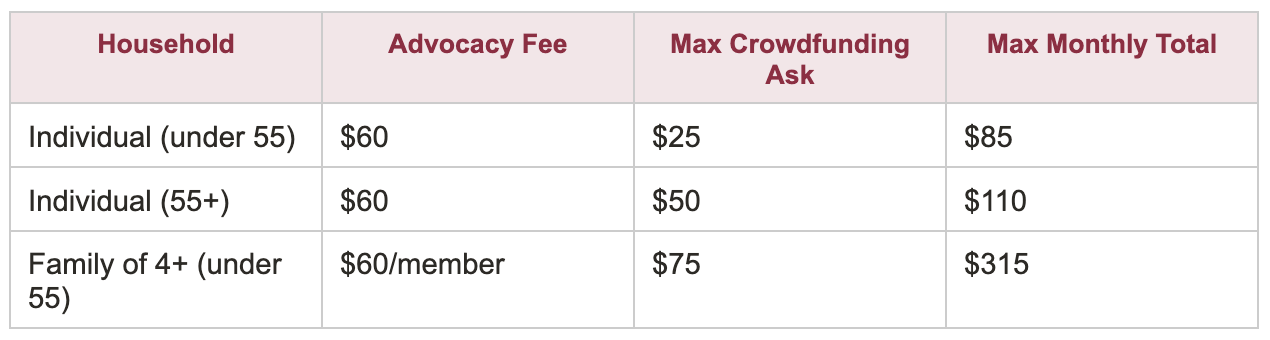
IMPORTANT BLACK SWAN LIMITATIONS:
The Member Commitment for Black Swan is $15,000 per health event — not $500. Pregnancies are not eligible at all. The Longevity Discount Program is not available to Black Swan members.
This tier is genuinely only appropriate if you are very healthy, have significant cash reserves to cover that $15,000 commitment if needed, and want catastrophic-only coverage at rock-bottom cost. It is not right for most families with kids or anyone who uses healthcare regularly.
What My Family Of 3 Actually Pays Monthly
For context: my husband, my son, and I are all on the Original Membership. We are all under 55.
Member Advocacy Fee: $60 x 3 = $180 per month. This is fixed, every month, no matter what.
Maximum Crowdfunding Ask: $140 x 3 =$420 per month. This would be the most they would ask for us to contribute into sharing. Most months it has been less.
So the absolute most we would ever pay in a month is $600 total. That’s what I budget for.
But here’s the thing: many months the actual crowdfunding ask is significantly less than the maximum. In April 2026, the average ask for a family of 4+ was $255.
When that happens, I take the difference between what I budgeted and what I actually paid and move it into a high-yield savings account that I earmark for medical expenses. So over time, we’re building a small cushion specifically for the $500 Member Commitment if and when we need it.
We went from $1,483 a month to a maximum of $600 — and most months it’s less than that. That’s over $1,000 back in our budget every single month.
That extra breathing room in our budget is part of why the $500 Member Commitment per health event doesn’t feel the way a traditional deductible does. With the insurance plans we had before, deductibles were often so high that we were rarely close to meeting them anyway, and then the year would reset.
We were paying in constantly and rarely getting meaningful coverage back out. With CrowdHealth, we’re saving over $1,000 a month and building a medical fund with the difference.
What CrowdHealth Benefits We've Actually Used
I get asked a lot whether CrowdHealth actually works when you need it. Here’s our real experience so far.
Every year, we use the Annual Wellness benefit. One wellness event per member per year — costing up to $300 — is eligible for crowdfunding without the $500 Member Commitment. Eligible events include primary care physicals, pediatric well-child visits, direct primary care membership fees, annual gynecological exams and labs, dental exams with cleaning and X-rays, and vision exams. We have used this every year.
We have also used some of the quarterly promotions—CrowdHealth periodically offers specials for things like DEXA scans and gut health testing. I have taken advantage of these, which has made proactive health testing genuinely affordable in a way it wasn’t before.
We recently opened our first actual Medical Event. My son had to see a specialist to rule out causes for some vision loss he was experiencing. The initial specialist visit was $300. I messaged my member advocate through the app the same day of the appointment, was able to check in as a cash pay patient, paid the fee, received an invoice, and uploaded it to the app that same day.
Within two days, it was confirmed that the medical event was eligible for funding once the total bills exceed $500. As we get referred to additional specialists, those bills will accumulate under the same event and eventually cross that threshold.
The speed and clarity of that response was so different from every prior health coverage experience I’ve had. No hold music. No claims department. A real person who answered my question in hours.
The Prescription Question (Because Everyone Asks)
Here is CrowdHealth’s answer on prescriptions: prescriptions related to a specific health event that occurs while you are a member are eligible for crowdfunding by the community for up to 12 consecutive months. Prescriptions lasting longer than 12 months are not eligible for crowdfunding, but regardless of timeline, you have access to their pharmacy discount partner, which can reduce prescription costs by 50–60%.
Our family’s only prescription experience so far: I needed a migraine medication, my direct primary care doctor gave me a coupon, and I got multiple months’ supply for $10. That’s been it. We are a relatively healthy family who invests in prevention — chiropractic care, supplements, working with a nurse coach — and we use direct primary care providers for both myself and my son, which means we can usually address issues early before they become more expensive urgent or emergent situations.
If you are managing a chronic condition that requires ongoing daily prescriptions, CrowdHealth’s prescription coverage is limited in ways that matter for your situation. I’ll cover that more in the “who this isn’t for” section below.
The Longevity Discount: Up to 20% Savings (with qualification)
CrowdHealth offers a Longevity Discount Program that can reduce your monthly crowdfunding ask by 10–20% if you meet specific health benchmarks.
Here’s how it works: eligible members (primary account holder and spouse, if applicable) complete at least one of three approved health tests during the enrollment window. The tests are a Fasting Insulin test (must be below 5 µIU/mL), a High Sensitivity C-Reactive Protein test (must be below 1 mg/L), or a DEXA scan for visceral fat (must be in the bottom quartile for age and gender). Pass one test per adult and you get 10% off. Pass two tests per adult and you get 20% off.
Important: if two adults are on the account, both must participate and pass. If only one passes, there is no discount. The enrollment window for a 2027 discount opens October 1, 2026. Tests are eligible for crowdfunding (up to $25 per lab test, $100 for a DEXA scan).
I’ll be honest with you: I do not currently qualify. I’m at an average weight and am actively working on reducing inflammation. My husband might qualify if he took the tests, but since both adults have to pass to receive the discount as a household, we wouldn’t benefit as a family right now. I’m not going to pretend this is a discount everyone can easily access — the benchmarks are intentionally strict. But if you are someone who is already tracking these health metrics and living a genuinely health-forward life, this is a meaningful reward for that.
The Longevity Discount is only available on the Original Membership, not Black Swan.
Who CrowdHealth Is NOT Right For
This is the part most affiliates skip. I’m not going to do that.
CrowdHealth is not currently open to tobacco users (defined as having used tobacco products every day for a period of a year or more at any time in your life).
It is also not open to those who weigh over 220 pounds (female) or 260 pounds (male).
And CrowdHealth does not offer membership to anyone over the age of 65.
For previously diagnosed or documented health conditions: no costs associated with those conditions are eligible for crowdfunding in the first or second year of membership. Starting in the third year, up to $25,000 in bills per year related to previously diagnosed conditions may be submitted for crowdfunding.
If you are managing ongoing chronic conditions, take daily medications that you rely on, or have significant pre-existing health issues that require consistent care, CrowdHealth can still work for you in some situations, but you need to go in with clear eyes about what will and won’t be eligible, especially in those first two years. I would strongly recommend booking a call with a member advocate before signing up so you can ask directly about your specific situation.
If you are pregnant or planning to become pregnant soon: the Member Commitment for maternity on the Original Membership is $3,000, not $500. That’s the amount you’ll pay before the crowd funds the rest. For many people this is still far more affordable than traditional insurance copays and hospital bills. And the medical event of childbirth will also include pelvic floor therapy or recovery support for the mother, which is kind of amazing. But you want to make sure to plan for and know that number going in.
Black Swan members: pregnancies are not eligible at all.
Why I Trust the 99%+ Funding Rate (And Why That Number Matters More Than People Realize)
The question I hear most from people on the fence is: “But what if they don’t cover me when I really need it?”
I understand the fear. We have been trained to trust insurance companies, even though the average health insurance claim denial rate is around 20%. One in five claims denied.
And yet somehow CrowdHealth—which funded 99.93% of eligible bills in April 2026, with an average time from submission to funds in your account of about 7 days — feels riskier to people.
Part of what helped me trust this is understanding the incentive structure. CrowdHealth’s revenue comes entirely from the $60 monthly advocacy fee that every member pays. They do not receive any portion of the crowdfunding money. They have no financial incentive whatsoever to deny your request—because they don’t profit from it either way.
What they are doing is reviewing bills to make sure they are legitimate, fairly priced, and in alignment with the Member Guide that everyone agreed to when they joined.
That’s it. The transparency files they publish every month—showing every complaint, every ineligible bill and why it was ineligible, every funding result—are something I have never seen a health insurance company come close to offering.
I will never go back to health insurance. I love knowing that my money is going to actual families navigating health events, instead of padding the profit and administrative bloat of insurance companies operating inside a broken medical system.
How to Sign Up (And What My Referral Link / Code Gets You)
The sign-up process is straightforward. You create an account, fill out forms that cover the membership eligibility questions—tobacco use, weight, age, number of members, and disclosure of any pre-existing conditions.
Once approved, you choose your start date, which you can push out to align with when your current insurance coverage ends. Then you download the app and can book a call with a member advocate who will walk you through the benefits and answer your questions.
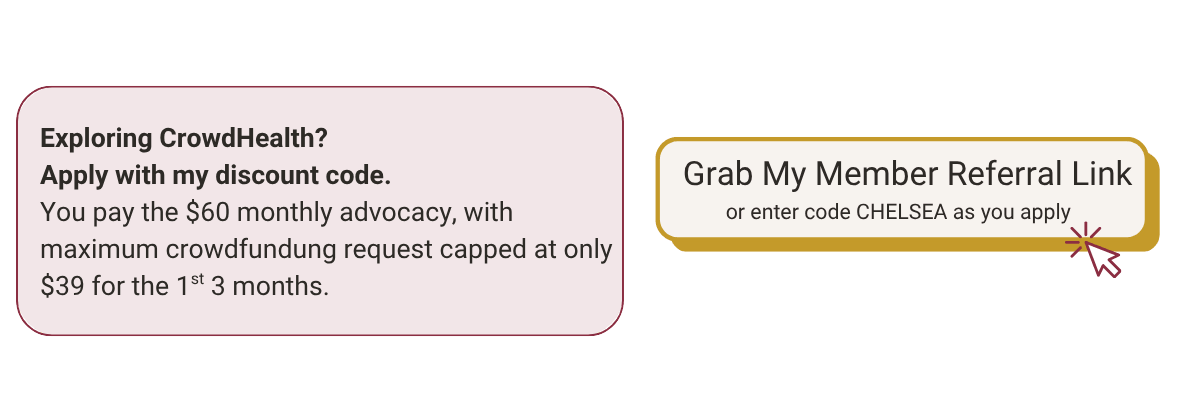
If you sign up using my referral link, here’s what happens: you still pay the $60 monthly advocacy fee per member, but your maximum crowdfunding ask is reduced to $39 for the first three months. For a family of three like mine, that’s real money back in your pocket while you’re getting started.
If you already started the application process, you can make sure they enter code CHELSEA as you enroll to get the same discount.
READY TO GET YOUR QUESTIONS ANSWERED?
If you’re still on the fence, the most useful thing you can do is book a free call with a CrowdHealth member advocate at JoinCrowdHealth.com. They will walk through your specific situation, answer your questions, and help you figure out if the math makes sense for your family. If it’s not a good fit, they will tell you. That’s the kind of company this is.
The math made sense for us. We went from $1,483 a month to a budgeted maximum of $600—and most months it’s less. That’s over $1,000 back in our budget every single month.
It can take a little while to understand how to navigate the process, but CrowdHealth is so transparent and helpful along the way that you can become a really savvy consumer of your own healthcare quickly. For a family of three, navigating variable income and all the mental load that comes with it, this has been one of the best adulting decisions we’ve made.
Some blog posts contain affiliate links or discount codes - when you use those links or codes, I will make a little money for referring you, paid directly from the company. It never costs you more to use my link, and I only recommend products, services and software I research, use and trust myself.
Your support is appreciated, as it helps to fund me creating more free educational content like this.